
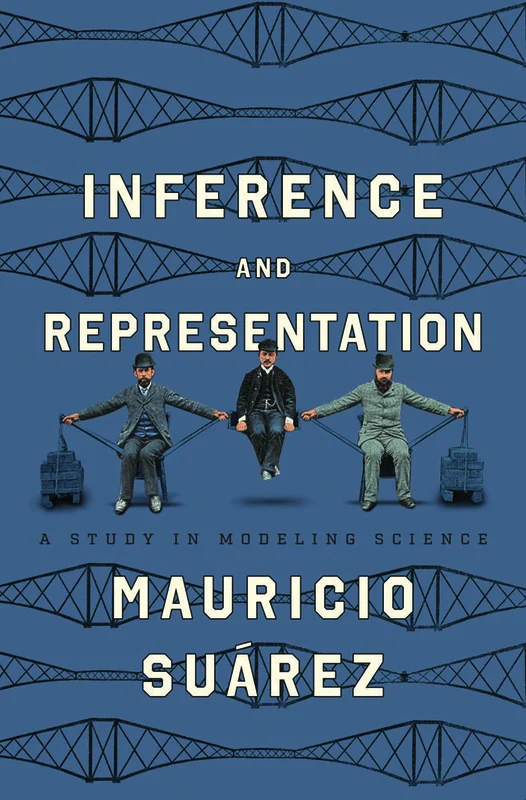
Description
By (author) Suárez, Mauricio
:
The first comprehensive defense of an inferential conception of scientific representation with applications to art and epistemology.
Mauricio Suárez develops a conception of representation that delivers a compelling account of modeling practice. He begins by discussing the history and methodology of model building, charting the emergence of what he calls the modeling attitude, a nineteenth-century and fin de siècle development. Prominent cases of models, both historical and contemporary, are used as benchmarks for the accounts of representation considered throughout the book. After arguing against reductive naturalist theories of scientific representation, Suárez sets out his own account: a case for pluralism regarding the means of representation and minimalism regarding its constituents. He shows that scientists employ a variety of modeling relations in their representational practice—which helps them to assess the accuracy of their representations—while demonstrating that there is nothing metaphysically deep about the constituent relation that encompasses all these diverse means.
The book also probes the broad implications of Suárez’s inferential conception outside scientific modeling itself, covering analogies with debates about artistic representation and philosophical thought over the past several decades.
Table of contents:
Preface and Acknowledgments
1 Introducing Scientific Representation
Part I Modeling
2 The Modeling Attitude: A Genealogy
3 Models and Their Uses
Part II Representation
4 Theories of Representation
5 Against Substance
6 Scientific Theories and Deflationary Representation
7 Representation as Inference
Part III Implications
8 Lessons from the Philosophy of Art
9 Scientific Epistemology Transformed
Notes
References
Index
Review quote:
“Suárez’s book provides one of the most original and compelling accounts of representation to emerge thus far in the twenty-first century. His ambitious account is amenable to wide-ranging cases of cognitive representation and its minimal requirements ensure that it captures diverse cases of modelling practice across disciplines.”
Review quote:
“Suárez’s book is a richly argued model of scholarship that sets the standard for future investigations into scientific representation.”
Review quote:
“In Inference and Representation, Suárez develops a book-length treatment of [the] inferential conception and why we should prefer it to some of its more substantive competitors. What results is a discussion that situates the conception in . . . historical context; enriches our understanding of the conception itself; and explores how it relates to and informs adjacent issues such as the structure of scientific theories, the nature of pictorial representation, and scientific epistemology in general. In doing so, it serves to coherently tie together a career’s worth of work on the nature of scientific modeling and expand that project in several intriguing ways. This is no mean feat.”
Review quote:
“Brilliantly crafted, Inference and Representation excels at the difficult task of reconciling theory and practice, as it manages to bring theory back to earth and inform modeling practices in their contexts at the same time.”
Review quote:
“Beautifully bringing together historical and contemporary research on representations in science with themes from aesthetics and the philosophy of art, Suárez’s book is an outstanding interdisciplinary contribution to the philosophy of science. It is essential reading for anyone interested in modeling practices, their connections with the arts, and what this insightful combination of science, art, and practice might bring to the epist




Reviews
There are no reviews yet.