
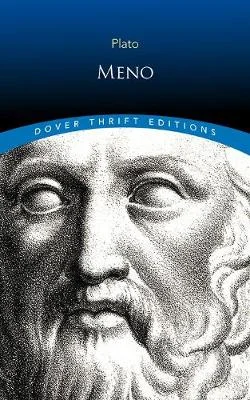
Description
By (author) Plato
Short /annotation:
Important and influential Socratic dialogue addresses some of philosophy”s most fundamental questions, including the definition of virtue and the nature and possibility of a priori (innate) knowledge. Jowett translation.
:
What is virtue? Can it be learned or is it innate? Is it possible to know things a priori (before experience)? In this important and influential Socratic dialogue, Plato addresses a wealth of philosophy”s fundamental questions, including the difference between actually knowing something and merely maintaining a correct belief about it.
The dialogue begins when Meno, a young aristocrat from Thessaly, confidently declares that he can define virtue – only to be reduced in short order to utter confusion, a fate common to those engaging in debate with Socrates.
Meno”s contention that a concept cannot be defined without knowledge of its nature leads to one of the most celebrated passages in the history of philosophy: Socrates asserts the doctrine of reincarnation, and by posing a mathematical puzzle to Meno”s slave, demonstrates the existence of innate knowledge. This brief but profound dialogue, which forms the basis for subsequent examinations of a priori knowledge, appears here in the translation by the distinguished scholar Benjamin Jowett.
Biographical note:
Plato ranks among the most familiar ancient philosophers, along with his teacher, Socrates, and his student, Aristotle. In addition to writing philosophical dialogues – used to teach logic, ethics, rhetoric, religion, and mathematics as well as philosophy – he founded Athens” Academy, the Western world”s first institution of higher learning.


Reviews
There are no reviews yet.