
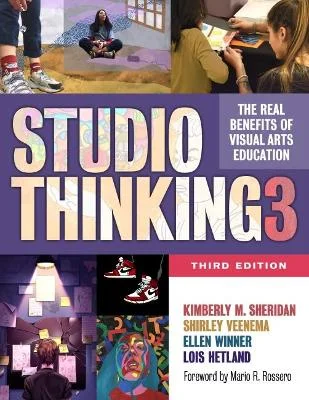
Description
By (author) Sheridan Kimberly M.; By (author) Veenema Shirley; By (author) Winner Ellen; By (author) Hetland, Lois; Foreword by Rossero, Mario R.
Short /annotation:
A new edition of a research-based account of teaching and learning in high school studio arts classes. The book poses a framework that identifies eight habits of mind taught in visual arts and four studio structures by which they are taught. This edition includes new material about how the framework has been used since the original study.
:
Studio Thinking 3 is a new edition of a now-classic text, a research-based account of teaching and learning in high school studio arts classes.It poses a framework that identifies eight habits of mind taught in visual arts and four studio structures by which they are taught. This edition includes new material about how the framework has been used since the original study, with new perspectives from artist-teachers who currently apply the Studio Thinking Framework in their own practice. It also reviews how contemporary organizations, educators, and researchers outside the arts have utilized the framework, highlighting its flexibility to inform teaching and learning. The authors have added a new chapter on assessment to introduce the practical and thoughtful ways that teachers are using Studio Thinking to assess and evaluate students” work, working processes, and thinking in the arts.
The first edition of this bestseller was featured in The New York Times and The Boston Globe for its groundbreaking research on the positive effects of art education on student learning across the curriculum. Studio Thinking 3 will help advocates explain arts education to policymakers, support art teachers in developing and refining their teaching and assessment practices, and assist educators in other disciplines to learn from existing practices in arts education.
Book Features:
- An explanation of “art as thinking” that unpacks and clarifies how teaching art is the process of teaching thinking.
- An account of what Studio Thinking looks like in diverse contemporary settings.
- Models of studio arts instruction that illuminate what educators are doing to support students” learning in the arts and why they are doing it that way.
- A new chapter with rich examples of approaches to assessment.
- New analyses on how studio art teachers support learner agency.
- Updated examples from practice showing how artist-teachers are using the Studio Thinking Framework.
- Full-color images with examples of student art.
Table of contents:
- Contents
- Foreword to the Third Edition by Mario R. Rossero ix
- Foreword to the First Edition by David N. Perkins xi
- Preface to the Third Edition xiii
- Acknowledgments xv
- 1. Making the Case for the Arts: Arts Education Is Not Just a Luxury 1
The Framework of Studio Thinking 1
Why a Frame for Studio Teaching and Learning? 2
Conclusion 5Part I. Studio Classrooms: The How of Studio Teaching
- 2. Elements of Studio Classrooms 13
Creating a Studio Culture 13
Focusing Thinking With Studio Assignments 15
Teaching Through Artworks 153. Studio Structures for Learning 18
The Demonstration–Lecture 18
Setting Tasks: African Pottery Project (Example 3.1) 19
Illustrating Concepts: Tile Project (Example 3.2) 20
Modeling Processes, Approaches, and Attitudes: Light and Boxes Project (Example 3.3) 21
Students-at-Work 22
The Critique 23
Variations in Use of the




Reviews
There are no reviews yet.