
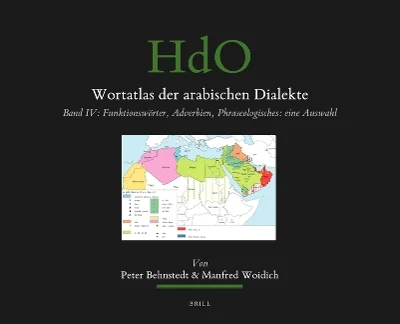
Description
بقلم (المؤلف) Behnstedt Peter ط› بقلم (المؤلف) Woidich Manfred
:
The Wortatlas der arabischen Dialekte / Word Atlas of Arabic Dialects (WAD) intends to provide an unprecedented survey of the lexical richness and diversity of the Arabic dialects as spoken from Uzbekistan to Mauretania and Nigeria, from Malta to Sudan, and including the Ki-Nubi Creole as spoken in Uganda and Kenya. The multilingual word atlas consists of four volumes in total with some 500 onomasiological maps in full colour. Each map presents a topic or notion and its equivalents in Arabic as collected from the dialectological literature (dictionaries, grammars, text collections, ethnographic reports, etc.), from the editors’ own field work, from questionnaires filled out by native speakers or by experts for a certain dialect region, and also from the internet. Polyglot legends in German, English, French, Spanish, Italian accompany the maps to facilitate further access. Each map is followed by a commentary in German, providing more details about the sources and the individual forms, and discussing semantic and etymological issues. All quotations are in their original language. The maps mainly show lexical types, detailed and concrete forms are given in the commentaries. An introduction is provided in Volume 1 in both German and English. Indices of all lexemes in the atlas will be available for each volume. The first volume Band I: Mensch, Natur, Fauna und Flora / Volume 1: Mankind, Nature, Fauna and Flora contains subjects such as ‘family members’, ‘professions’, ‘human qualities’. The second volume, Band II: Materielle Kultur, deals with material culture (‘house’, ‘utensils’, ‘food’, ‘clothing’, ‘vehicles’, etc.). The third volume Band III: Verben, Adjektive, Zeit und Zahlen focuses on verbs, and adjectives. The fourth volume Band IV: Funktionswörter und Phraseologisches contains functionwords and some phraseological items. The atlas is indispensable for everyone interested in the modern spoken Arabic language, as well as for dialectologists and for semanticists.
Table of contents:
Vorwort und Einleitung viiAbkürzungen ixAlphabetisches Kartenverzeichnis xiAlphabetical List of Maps XIIIKarten und Kommentare 1A. Allgemeines I,II Marokko UPs 4III Algerien/Tunesien UPs 7IV Sudan UPs 8V,VI Libanon/Israel UPs 9VII Jordanien/Sinai UPs 10VIII Irak UPs 11IX Saudi-Arabien/Oman UPs 12X Saudi-Arabien-SW/Jemen UPs 13B. Interrogativa439a wer? 17 440 welche(r)? 30 441 was? 41441a 44443a warum? 83443b warum? 87443c Andere Bildungen 91443d warum? Pragmatische Implikaturen 94444a wann? 109444b wann? Reflexe von *ʾaymatā 114444c wann? Analytische Neubildungen 117444d wann? Marokko 120444e,f wann? Ägypten und Jemen 123444g wann? Syrien 125444h wann? Antiochien und Anatolien 127444j,k,l wann? Palästina – Jordanien 129445a wo? 131445d,e Antiochien, Anatolien 137446a woher? 139446d Syrien: woher? 143446e Antiochien: woher? 145447a wie? 147447b wie? 153448a wieviel?, wie viele?, wie lange? 155448b wieviel?, wie viele?, wie lange? 160C. Demonstrativadverbien449a hier, *hunā und *hāhunā alsAusgangspunkte 167449c hier, erweiterte, diminutive und andere Formen 176450a dort 184450b dort, Reflexe von *hunāka, *hināka, *hāhunāka, *hāhināka ohneErweiterungen 189450c dort, erweiterte Formen, Varia 194450d dort, Marokko 197450e dort, Ägypten 199450f dort, Syrien 201450h dort, Antiochien, Anatolien 205450j dort, Jemen 207D. Weitere Lokativadverbien 451 draußen 211 452 drinnen 215453a rechts/recht(e) 219454a links 223454b links, Marokko 227454c,d links, Jemen/Antiochien 229455a geradeaus 231455b geradeaus 234455c geradeaus, Entl

Reviews
There are no reviews yet.